Balance Sheet Items
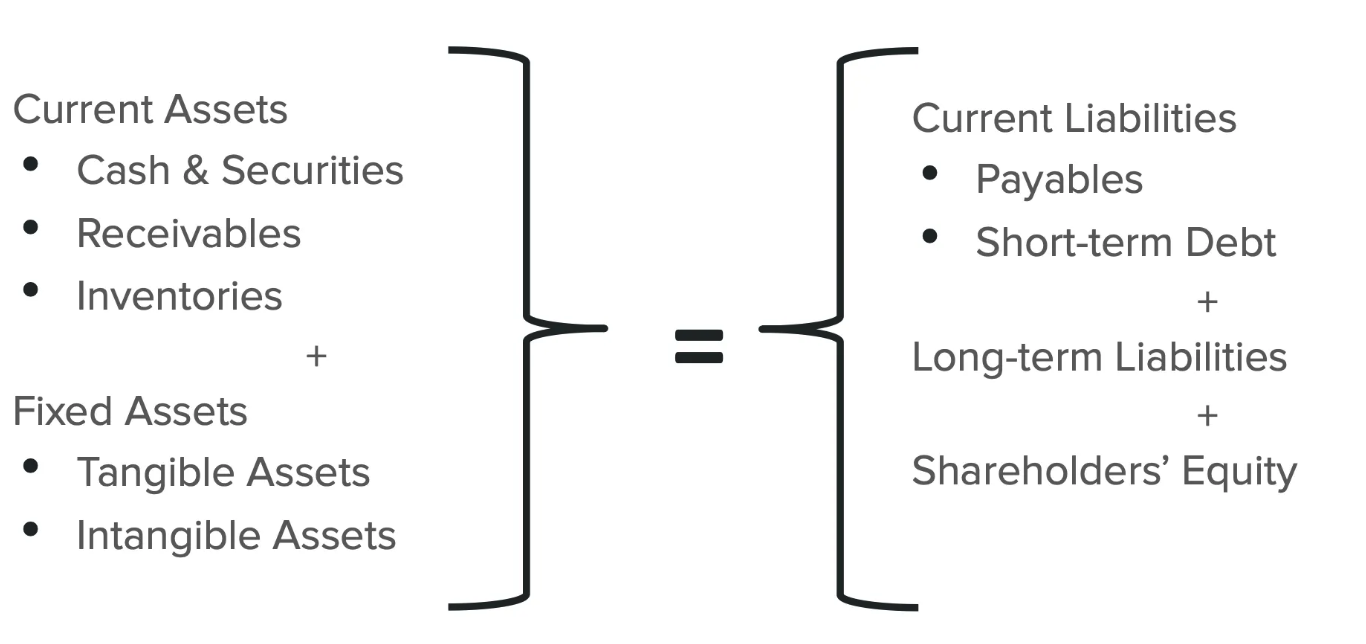
- Current Assets are short term assets that can be easily converted to cash, while fixed assets are long term and not liquid
- Payables include money which is yet to be paid such as owing money to suppliers
| Term | Formula |
|---|---|
| Shareholder’s Equity | Total assets - Total Liabilities |
| Net Working Capital | Current Assets - Current Liabilities |
| Net Income | Taxable Income - Taxes |
| Taxable Income | Total Revenue - Cost - Operating Expense - Deductions |
| Earnings Before Interest and Taxes (EBIT) | total revenues + other income - costs - depreciation |
| Free Cash Flow | Net Income + interest + depreciation - additions to net working capital + Cashflow from Investments Interest + Cashflow from Operations + Cashflow from Investments |
Book Value vs Market Value
Book values is the value of a company according to the balance sheet. While market value is the value of a company in the perspective of the market and investors
Usually market value is higher than the book value
Info
So where is this additional money going to? If the market value is higher than book value?
This additional money will be passed around by investors. This will not change the book value of the company
It is important to note that the company do not gain more money from an increase in market value. A company only receives money from investors during IPO and Secondary Offering
The Income Statement
Financial statement that shows the revenues, expenses, and net income of a firm over a period of time (from an accounting perspective).
Question
What is the difference between profit and taxable income?
| Feature | Profit (Net Income) | Taxable Income |
|---|---|---|
| Definition | The final earnings of a company after deducting all expenses (including taxes). | The portion of income that is subject to tax, calculated before taxes are applied. |
| Formula | Revenue - COGS - Operating Expenses - Interest - Taxes | Revenue - COGS - Operating Expenses - Allowable Deductions (but before taxes are subtracted) |
| Includes Taxes? | ❌ No, taxes are already deducted. | ✅ No, but it determines how much tax will be paid. |
| Used for? | Measuring the company’s financial performance. | Used by tax authorities to determine tax liability. |
Accural Accounting
Accrual accounting is a method where revenues and expenses are recorded when they are earned or incurred, rather than when cash is received or paid. This method follows the matching principle, meaning income and related expenses are recorded in the same period.
Cash Flows
There can only be three uses of cash
- Cash provided by operations
- Cash flows from expenditure
- Cash provided for financing activities
Taxation Principles
Corporate Tax Rate is 21% in the US. In case of losses, the firm can carry the losses forward, using the losses to offset up to 80% of future years’ income. Interest is not taxable.
Personal Income Tax
Marginal Tax Rate is the tax that the individual pays on each extra dollar of income Average Tax Rate is the total tax bill divided by total income